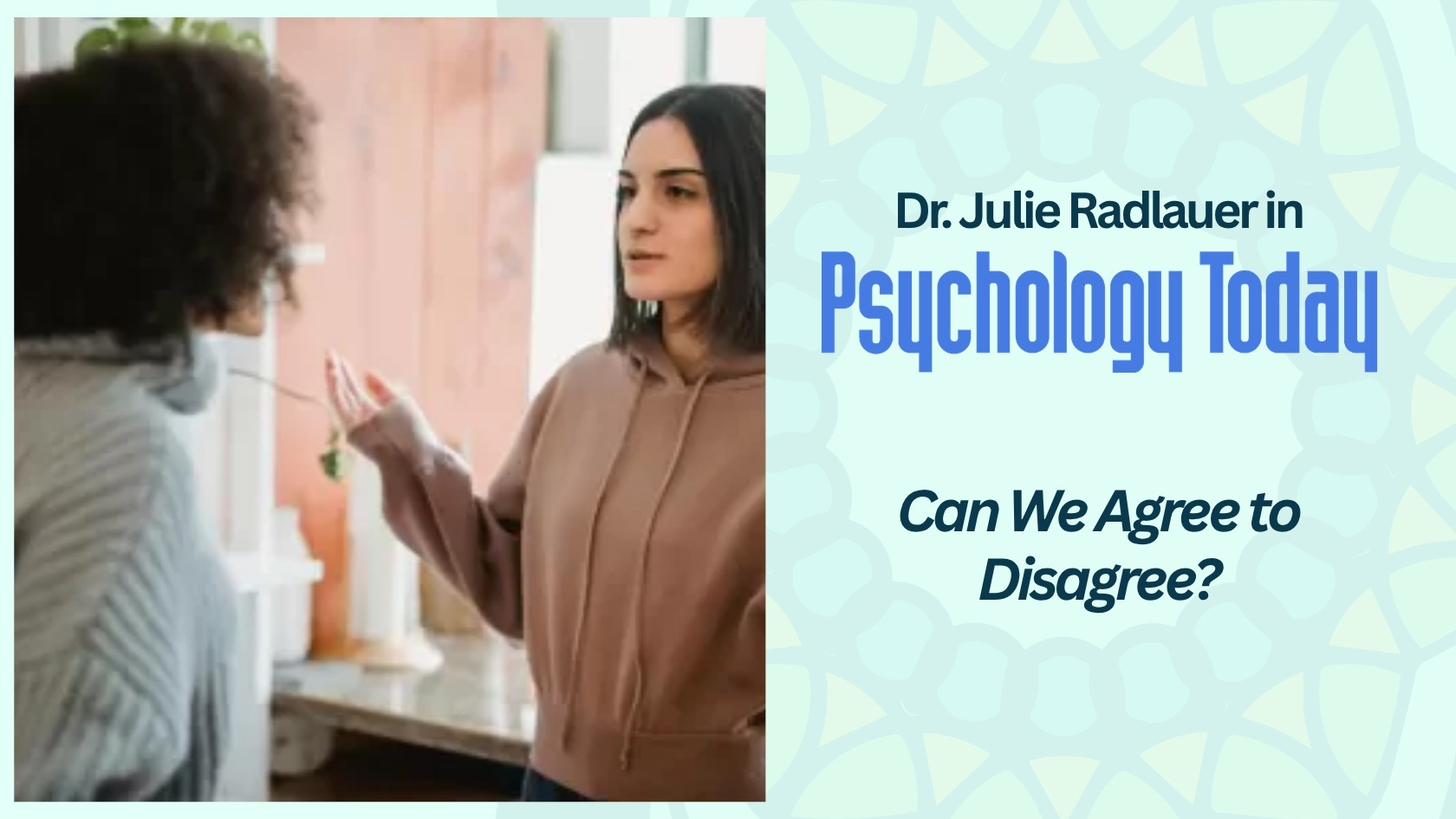
Originally published in Psychology Today, June 25, 2025
Half a century ago, for many people, the biggest relationship dealbreaker was race; today, the line is drawn when it comes to politics. According to a Pew Research study, 7 in 10 Democrats would not date someone who voted for President Trump. But this preference for one’s own tribe extends into platonic relationships as well. A YouGov survey published last year found that 26 percent of the 14,636 polled reported ending a friendship because of a political disagreement.
It feels like we say it every year, but nowadays Americans are more divided than ever. Three hotly contentious elections, divisive politics, and throw in a pandemic for good measure, and you get a nation full of people who are more than willing to immediately swipe left on anyone who doesn’t align with their beliefs.
What makes this rapid-fire rejection worse is that we’re also suffering from a loneliness epidemic, where one in three Americans report feeling lonely every week, and another 12 percent report not having any friends at all.
It’s easy to slowly disengage with a long-time friend on account of a change in their politics, but what if conversing with people who have opposing views gives us the social tools we need to combat loneliness by forming deep, meaningful relationships with people from all walks of life?
Don’t think reconciling with someone who gets their news from a different source is possible? If people from opposite sides of the gun rights issue can get together in a room and form bonds with one another, so can you.
If there is one thing everyone in this country has an opinion on, it’s guns. Whether we should ban them, buy more of them, teach school teachers how to fire them, or increase the amount of background checks, everyone is willing to offer their opinion.
And so it wasn’t too difficult when, in 2018, Essential Partners, a nonprofit with the goal of helping individuals build relationships, sought out Americans with strong opinions on gun ownership. They wanted to do something extraordinary: gather people with opposing views on gun control, put them in the same room, and make them have a civil conversation.
They didn’t just throw a bunch of opinionated people in a room and tell them they’d only be let out once they learned to live in peace. Instead, the organizers taught the participants a set of communication skills designed to build empathy and help them understand someone else’s opposing point of view. Understanding why the person across the table cares so deeply about an issue is a must if you wish to end the conflict.
In short, they were taught not only how to listen but how to prove to the other person they were being listened to.
Early on in this two-day experiment in DC, a man who owned so many guns he had lost count sat down with a fierce gun control activist. When they used their newfound communication skills, they were able to connect rather than dig their heels in and prove their point.
After he was finished speaking, his listening partner asked him questions to better understand his point of view. Once this man had felt heard, he took his counterpart’s hand and said, “It feels like such a relief to hear you say it that way. Thank you for hearing me.” He later went on to tell Charles Duhigg, author of Supercommunicators, that despite it being with a stranger, this conversation had been one of the most meaningful of his life.
At the end of the experiment, tears were shed, conversations instead of shouting matches were had, and nearly everyone was able to find common emotional ground.
I’m not saying that once we learn how to listen, we’ll all get along. Disagreements are inevitable, and when we learn to respect differing viewpoints, we humanize one another and, most importantly, learn how to quickly build bonds with people we think we have nothing in common with.
Another important aspect of this challenge is understanding the person’s perspective or how they view the world. People who tend to lean left look at the world in terms of how policies and practices impact the greater good. They may not need to know someone to be passionate about that person’s rights. On the other hand, those who are more conservative tend to be more impacted when they know a person who is directly affected.
This worldview holds true for both complete strangers and close family and friends. In fact, there is evidence that a contributor to our loneliness epidemic is that deep ties have decreased significantly over the past 20 years, in part because people have grown apart figuratively as well as literally.
This truly makes the case for why we need to have conversations with people outside our circle, as well as those with whom we have longstanding relationships. It turns out that doing this is actually quite simple.
Follow these steps:
Conversing with people makes us more receptive and provides us with the social tools we need to form relationships with individuals from diverse backgrounds. These relationships can lead to deep and meaningful connections, ultimately contributing to our overall happiness.
References
https://www.pewresearch.org/short-reads/2020/04/24/most-democrats-who-are-looking-for-a-relationship-would-not-consider-dating-a-trump-voter/
https://today.yougov.com/topics/politics/survey-results/daily/2024/08/16/4aa50/2
https://www.psychiatry.org/news-room/news-releases/new-apa-poll-one-in-three-americans-feels-lonely-e
https://bigthink.com/neuropsych/americans-no-friends/
https://whatisessential.org/charles-duhigg-spotlights-ep-guns-dialogue-supercommunicators
Duhigg, C. (2024). Supercommunicators: How to unlock the secret language of connection. Random House
Share: